Industry News
Home > News > Industry News > 2026: The iteration of drone battery technology accelerates: Ultra-high specific energy solid-state batteries enter mass production, marking a qualitative chang
In 2026, the industrialization process of low-altitude economy in China continues to accelerate. Large-scale applications of unmanned aerial vehicles (UAVs) and eVTOLs have been realized. The three major battery challenges that have long constrained the industry - short battery range, low payload capacity, and insufficient safety - have achieved concentrated breakthroughs. With the mass production of semi-solid batteries, the iterative improvement of ultra-high specific energy new battery technology, the upgrade of intelligent battery systems, and the official implementation of the national standard for power safety of UAVs, the UAV battery industry officially bid farewell to the traditional liquid lithium-ion battery bottleneck and entered a new stage of high energy density, high safety, intelligence, and long flight duration. This laid a solid power foundation for the large-scale commercial use of low-altitude economy.
At the recently concluded 2026 Shenzhen UAV Exhibition, multiple cutting-edge battery technologies in the production stage were showcased, marking a complete shift from laboratory research to commercialization implementation in UAV power technology. Taolan New Energy officially unveiled a full series of dedicated solid-state battery cells for UAVs, covering multiple energy density product gradients. Among them, the 380Wh/kg high-power semi-solid battery has achieved stable mass production, and the 400Wh/kg pure silicon anode battery has entered the batch delivery stage. Moreover, the 500Wh/kg lithium metal battery and 550Wh/kg ultra-high specific energy battery have completed technical finalization, setting new domestic records for UAV battery energy density. According to the company's public information, its solid-state battery production base in Hubei Qianjiang is steadily advancing construction and will have an annual production capacity of over 10 million cells after full production, which can fully meet the supply needs of industrial UAVs, heavy-duty UAVs, and special aircraft, and solve the problem of insufficient battery capacity for high-end UAVs.
In addition to the industrialization breakthrough of solid-state batteries, the industry's diversified technical routes have also flourished simultaneously, providing comprehensive solutions for different scenarios of UAV operations. For long-duration operation scenarios, semi-solid batteries have achieved practical performance breakthroughs. The custom UAV equipped with a 320Wh/kg high-energy-density semi-solid battery can complete a 3-hour and 31-minute continuous flight test after a single charge, with a range improvement of nearly twice compared to traditional lithium-ion batteries, completely breaking the conventional shortcomings of consumer-level and industrial-level UAVs in terms of range. For the 100kg-class heavy-duty UAV market, the TATTU 5.0 series intelligent battery platform of Greep has been officially launched. It abandons the single-cell upgrade model and creates a system-level power solution integrating high-rate discharge, low-temperature rise control, rapid charging, intelligent BMS management, and full lifecycle data monitoring, effectively solving the industry pain points of unstable high-load flight power, low charging efficiency, and high maintenance costs for heavy-duty UAVs, and adapting to high-intensity operation scenarios such as logistics transportation, power inspection, and mapping exploration.
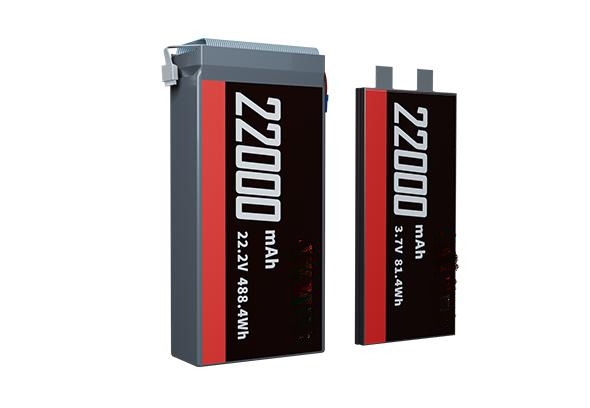
The frontier research field has also achieved a leapfrog breakthrough, providing core driving force for the long-term technological iteration of the industry. The research team from Tsinghua University recently announced the results of the new lithium-sulfur battery technology, optimizing the sulfur electrochemical system through intelligent molecular framework programming and successfully developing a 14.2Ah soft-pack lithium-sulfur battery with an energy density of 549Wh/kg, achieving 800 stable charge and discharge cycles, combining the advantages of ultra-high specific energy and long lifespan. Its performance far exceeds the current mainstream commercial UAV batteries, providing a new technical path for the development of ultra-long-duration special UAVs. At the same time, Enli Power has launched the "Enli Tianyi" series of aviation-grade solid-state battery cells, covering all specifications from 22Ah to 40Ah. With its lightweight, high-rate, and wide temperature range comprehensive performance, it fully meets the power requirements of industrial UAVs, heavy-duty UAVs, and eVTOL aircraft, expanding the performance boundaries of low-altitude equipment.
While technological iteration is ongoing, industry compliance standards are continuously improving, promoting the standardization and high-quality development of the UAV battery industry. The mandatory national standard "Safety Requirements for Civil Unmanned Aircraft System" that will be officially implemented in 2026 clearly stipulates mandatory technical indicators such as fire prevention, explosion prevention, and heat runaway prevention for the power energy system of unmanned aircraft. This completely eliminates the industry chaos where there was no unified safety regulation for drone batteries, forcing enterprises to upgrade electrode materials, structural design, and protection systems. Industry experts stated that after the implementation of the new standard, old liquid batteries with low energy density and low safety will be accelerated to be eliminated, and high safety and high specific energy solid-state batteries and intelligent batteries will become the mainstream in the market.
The technological layout rhythm of leading enterprises in the industry continues to accelerate, and the technical iteration path is clear. BAK Battery has clearly defined the technical iteration plan and will focus on promoting the industrialization of 450Wh/kg semi-solid batteries in 2026. It is expected to achieve large-scale application of all-solid-state batteries in 2028 and continue to deeply focus on the low-altitude power field of unmanned aircraft. Looking at the global market, overseas enterprises are also accelerating their layout of high-end drone batteries, and lithium metal batteries and special batteries with long storage life are continuously breaking through. The competition in the low-altitude power battery field at home and abroad is becoming increasingly fierce.
Industry analysts pointed out that as a core component of the low-altitude economy, the technological breakthrough of drone batteries directly determines the operational capabilities and application boundaries of low-altitude equipment. In 2026, the industry is at a critical turning point of transitioning from liquid batteries to solid-state batteries and upgrading from single cells to intelligent power systems. With the maturity of production technology, capacity release, and standard improvement, long flight time, large load capacity, high safety, and intelligence will become the core labels of drone batteries. In the next two years, the large-scale implementation of new high-specific-energy battery systems will further promote the popularization and application of unmanned aircraft in low-altitude logistics, emergency rescue, smart cities, and aviation exploration, continuously releasing the industrial dividends of the low-altitude economy.