Battery Knowledge
Home > News > Battery Knowledge > Lithium-ion power batteries: the "steel heart" driving new energy vehicles
The roar of electric vehicles comes from a beating "heart."
This heart is the lithium-ion power battery. It is not merely a simple energy storage device, but rather the core component that determines driving range, acceleration performance, service life, and even the overall vehicle safety.
1. Working Principle of Lithium-Ion Batteries: The "Rocking Chair" Journey of Ions
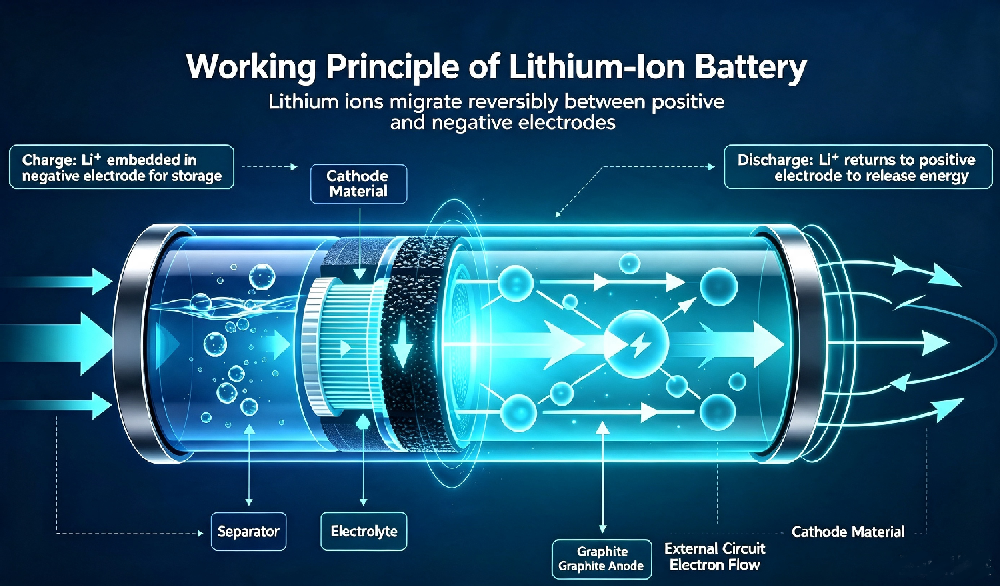
Lithium-ion batteries are vividly referred to as "rocking chair batteries" due to their unique operating mechanism. Why?
During charging, lithium ions are extracted from the positive electrode material, travel through the electrolyte and separator, and intercalate into the graphite layers of the negative electrode. During discharging, this process reverses completely. Lithium ions shuttle back and forth between the anode and cathode, much like rocking back and forth on a rocking chair, in a continuous cycle. This reversible chemical reaction forms the physical basis for the battery's repeated charging and discharging.
The internal structure of a battery cell is precise and complex. The cathode material typically uses ternary materials (NCM/NCA) or lithium iron phosphate (LFP), while the anode is mostly graphite. The electrolyte facilitates ion transport, and the separator serves a dual role in physical isolation and safety protection. The selection of materials and design of microstructures for each component directly affect the battery's performance.
II. Core Parameter Analysis: The Engineering Language Behind the Numbers
Energy Density: The Decisive Factor for Range
Energy density, measured in watt-hours per kilogram (Wh/kg) or watt-hours per liter (Wh/L), refers to the amount of electrical energy that can be stored per unit mass or volume. It is the key metric for evaluating a battery's "energy storage capacity."
Lithium-ion batteries with ternary materials can achieve an energy density of 200–300 Wh/kg, while lithium iron phosphate batteries reach 150–180 Wh/kg. Higher energy density means longer driving range for the same weight, which is precisely why high-end electric vehicles favor ternary lithium batteries. However, increased energy density often comes at the cost of reduced thermal stability—an enduring trade-off in engineering design.
Voltage Parameters: The "Potential Map" of a Cell
Voltage is the fundamental dimension for understanding battery state. The operating voltage range of a single cell typically lies between 2.5V and 4.2V (depending on the cathode material), with a nominal voltage of approximately 3.6–3.7V.
The total voltage accuracy requirements are extremely stringent. According to the GB/T 38661-2020 standard, the measurement error must be ≤±1% FS, while in passenger vehicle projects it is often tightened to ±0.5% FS. Cell voltage accuracy is equally critical, with typical requirements of ≤±5–10 mV. Why such strict standards? Because the BMS (Battery Management System) relies on precise voltage measurements to assess cell conditions, detect anomalies, and trigger protective measures. Even millivolt-level deviations can lead to inaccurate SOC estimation, delayed protection responses, or even safety incidents.
SOC and SOP: The "Health Dashboard" of Batteries
SOC (State of Charge) indicates the percentage of remaining capacity relative to the battery's rated capacity. It is the parameter users perceive most directly—much like the fuel gauge in a gasoline-powered vehicle.
However, accurately estimating SOC is by no means easy. Standards require a steady-state error of ≤5%, and validation must be conducted across different SOC ranges (>80%, 30%-80%, <30%) and multiple temperature conditions. In engineering practice, we employ the ampere-hour integration method combined with open-circuit voltage and Kalman filtering algorithms, along with a capacity learning mechanism to achieve error convergence. Each charge-discharge cycle serves as a test of the algorithm's robustness.
SOP (State of Power) represents the maximum power that a battery can continuously deliver or accept under its current state. It directly determines the vehicle's acceleration capability and braking energy recovery efficiency. SOP estimation requires comprehensive consideration of voltage limits, current limits, temperature constraints, and SOC boundaries, making it a multi-constraint optimization problem.
Cycle Life: The Hidden Leverage for Cost Efficiency
Cycle life refers to the number of charge and discharge cycles a battery undergoes before its capacity degrades to 80% of its rated capacity.
Lithium-ion batteries have a cycle life of approximately 1,000 to 2,000 cycles, while lithium iron phosphate (LFP) batteries can reach 3,000 to 5,000 cycles. What does this mean? Assuming a full charge provides a range of 500 kilometers, an LFP battery could theoretically support 1.5 to 2.5 million kilometers of driving—far exceeding the entire lifespan of most vehicles. This is precisely why LFP batteries dominate in commercial vehicle applications: longer service life and lower total lifecycle cost.
However, cycle life is not constant. Deep discharging, high-rate charging and discharging, and extreme temperature conditions can all accelerate capacity degradation. In engineering practice, we slow down the aging process through refined thermal management, optimized charging strategies, and SOC window limitations.
Temperature Characteristics: Challenges and Opportunities Coexist
Batteries are delicate creatures that fear both cold and heat.
In low-temperature environments, the ionic conductivity of the electrolyte decreases and electrochemical reaction activity diminishes, resulting in a sharp drop in available capacity, a significant increase in internal resistance, and restricted charging. The dramatic reduction in driving range during winter in northern regions is a direct manifestation of this low-temperature effect. Standards require temperature measurement accuracy within the -20°C to 65°C range to be ±1–2°C, with drift and response time also needing to be controlled.
High temperatures intensify side reactions, accelerate SEI film growth, and increase the risk of thermal runaway. Therefore, thermal management systems (TMS) have become a critical focus in battery pack design—liquid cooling, air cooling, phase-change materials, and various other technologies each demonstrate their strengths, all aiming at one goal: maintaining cell temperature within the optimal operating range (typically 15–35°C) and ensuring uniform temperature distribution.
Safety Performance: An Unbreachable Red Line
Safety is the lifeline of electric vehicles.
Standards clearly specify requirements for overvoltage, undervoltage, overcurrent, short-circuit, and overtemperature protection, with precise thresholds and hysteresis values required to ensure reliable operation. Overvoltage protection: when the cell voltage exceeds the charging cutoff voltage (e.g., 4.25V), a level-one alarm is triggered; if it continues rising to a dangerous threshold (e.g., 4.35V), level-two protection activates and forcibly disconnects the charging circuit. Overvoltage typically results from charging control failure or deteriorating cell consistency. Undervoltage protection: power limitation is initiated when the discharge cutoff voltage (e.g., 2.8V) is reached, while extreme undervoltage (e.g., 2.5V) immediately cuts off the load. Deep undervoltage can cause irreversible damage such as copper dissolution and SEI film degradation on the anode. Overcurrent protection: distinguishes between sustained and transient overcurrent. Sustained overcurrent (e.g., 1.5C for 10 seconds) triggers power reduction, while extreme overcurrent (e.g., above 3C) immediately opens the main circuit. Design must comprehensively consider cell rate capability, thermal management performance, and connector current-carrying capacity. Short-circuit protection: detects rapid current changes (dI/dt) combined with absolute value assessment, with typical response time under 10ms, forming a triple safeguard via pre-charge resistor, main relay, and fuse. Overtemperature protection: charging and discharging have different temperature windows—charging is usually limited to 0–45°C, while discharging may extend to -20–55°C. Exceeding the upper limit triggers power limitation, and at extreme temperatures (e.g., 60°C), forced shutdown occurs. Monitoring of maximum, minimum, and temperature differences is essential. Behind these cold numbers lie countless failure mode analyses, boundary condition validations, and extreme condition tests. Every protection strategy has been forged through hard-earned lessons.
III. The Debate Over Technology Pathways: The "Dual-Horse Race" Between NMC and LFP
The current power battery market features a competitive landscape dominated by lithium iron phosphate (LFP), with nickel-cobalt-manganese oxide (NMC) serving as a supplementary option.
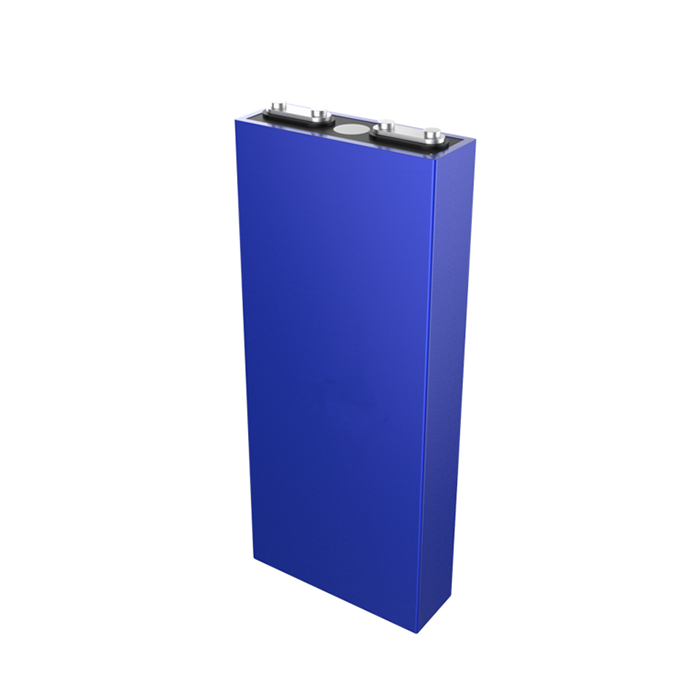
Lithium iron phosphate (LFP) batteries, with their excellent safety, long lifespan, and cost advantages, have become the mainstream in the market. Meanwhile, lithium nickel cobalt manganese oxide (NCM) batteries, thanks to their high energy density and superior low-temperature performance, maintain an edge in premium vehicle models. Innovative technologies such as BYD's Blade Battery and CATL's battery further enhance the energy density of LFP batteries through structural optimization, narrowing the performance gap with NCM batteries.
The future? New technologies such as solid-state batteries and sodium-ion batteries are poised to trigger another wave of technological revolution.
Conclusion
Lithium-ion power batteries represent the culmination of materials science, electrochemistry, thermodynamics, and control theory. Every parameter is linked to complex physicochemical processes; each specification embodies the wisdom and hard work of engineers.
As the "heart" of new energy vehicles, it not only propels the vehicle forward but also embodies humanity's vision for clean energy and sustainable development. Understanding it enables better control; respecting it ensures safer use.
This is the charm of lithium-ion power batteries.