Battery Knowledge
Home > News > Battery Knowledge > The structure and advantages of sodium-ion batteries explained in one article!
With the rapid development of the new energy industry, the price fluctuations, safety and cost issues of lithium resources have drawn increasing attention. Sodium-ion batteries have gradually become a new focus of the global battery industry. Especially in the latest consumption tax policy, sodium-ion batteries have been included in the scope of exemption from consumption tax, further sending a signal from the country to support the development of new battery technologies.
So, what exactly is a sodium-ion battery? What is its structure? Compared to lithium-ion batteries, what advantages does it have?
What is a sodium-ion battery?
A sodium-ion battery (Sodium-ion Battery, abbreviated as SIB) is a new type of secondary battery that uses sodium ions (Na⁺) to move back and forth between the positive and negative electrodes to achieve charging and discharging.
Its working principle is very similar to that of lithium-ion batteries, except that "lithium ions" have been replaced by "sodium ions".
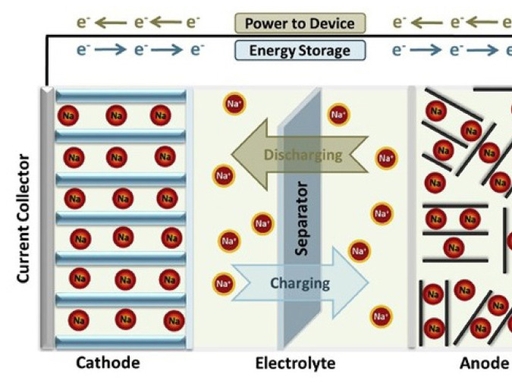
When charging, sodium ions are released from the positive electrode and migrate through the electrolyte to the negative electrode for storage.
When discharging, sodium ions return to the positive electrode from the negative electrode, while electrons pass through the external circuit to form an electric current, providing power for equipment.
In simple terms, electrons flow in the external circuit, sodium ions flow inside the battery, and together they complete the energy transfer.
What are the components of a sodium-ion battery?
A complete sodium-ion battery mainly consists of six major parts.
① Positive electrode material (about 30% - 40%).
The positive electrode is an important place for sodium ion storage and release, and is also the core part that determines the battery performance. Currently, the main technical routes mainly include three types:
Layered oxides: High energy density, low cost, and the easiest to achieve industrialization; representative enterprises: Nidec, Zhongke Haishan, etc.
Prussian blue (white) material: Fast charging and discharging, good low-temperature performance, low cost. Currently, it is attracting more and more industry attention.
Polyanion materials: High safety, long cycle life, good thermal stability, more suitable for energy storage fields.
② Negative electrode material (about 15% - 20%)
Different from lithium-ion batteries. Due to the larger volume of sodium ions, they cannot be as densely embedded in graphite as lithium.
Therefore, currently, hard carbon (Hard Carbon) is mainly used. This is the most industrialized negative electrode solution. The advantage is low cost, long cycle life, and excellent low-temperature performance. It may also adopt new materials such as soft carbon in the future.
③ Electrolyte (about 10% - 15%)
The electrolyte is responsible for the transportation of sodium ions. It generally includes sodium salts, organic solvents, and additives; it determines the conductivity, cycle life, and safety performance.
④ Separator (about 8% - 10%)
The separator's function is: allowing sodium ions to pass freely, preventing direct contact between the positive and negative electrodes, and preventing short circuits. Currently, it is basically the same as that of lithium-ion batteries.
⑤ Current collector (about 10%)
Mainly includes positive and negative aluminum foils. This is one of the biggest characteristics of sodium batteries. Since sodium does not react with aluminum, both the positive and negative electrodes can use aluminum foil. While the negative electrode of lithium-ion batteries must use more expensive copper foil, just this one item can further reduce costs.
⑥ Battery Management System (BMS)
Responsible for voltage monitoring, temperature monitoring, balance management, and safety protection to ensure the stable operation of the battery.
What are the advantages of sodium-ion batteries?
First, the resources are abundant. Sodium element reserves are extremely high. There are approximately 1.08 trillion tons of sodium in seawater and about 2.6% of sodium in the earth's crust, much higher than lithium. Resources are almost not a concern.
Second, the cost is lower. Sodium resources are abundant, and there is no need to rely on lithium mines. The negative electrode uses hard carbon, and both the positive and negative electrodes can use aluminum foil. The overall material cost is significantly lower than that of lithium-ion batteries. With the advancement of industrialization, there is further potential for cost reduction in the future.
Third, the safety is higher. Sodium ions have relatively lower chemical activity, and the risk of thermal runaway is lower. The safety performance under needle puncture, compression, high temperature, etc. is usually better than that of ordinary lithium-ion batteries, so it is more suitable for large-scale energy storage. Fourth, it has better low-temperature performance. This is one of the greatest advantages of sodium batteries. Many lithium batteries significantly lose their performance when the temperature drops to -20℃, while sodium-ion batteries can still maintain good discharge capacity at -20℃ or even -40℃. Therefore, they are highly suitable for energy storage in northeastern, northwestern, and cold regions.
Fifth, they have fast charging and discharging speeds. Sodium ions diffuse quickly, enabling faster charging and discharging. They are suitable for scenarios such as frequency modulation, peak load regulation, energy storage, construction machinery, two-wheel vehicles, and low-speed electric vehicles.
Sixth, they have a long cycle life. Currently, many products have a cycle life of over 6,000 times. Energy storage products can even reach 8,000 to 10,000 times.
What are the shortcomings of sodium-ion batteries?
Although they have obvious advantages, there are still some shortcomings at present.
For example: The energy density is lower than that of lithium iron phosphate batteries.
Currently, sodium batteries typically have an energy density of 140 to 180 Wh/kg. Lithium iron phosphate batteries typically have an energy density of 160 to 210 Wh/kg. Lithium cobalt oxide even exceeds 250 Wh/kg. Therefore, in the field of long-range energy storage for new energy vehicles, lithium batteries still hold the advantage.
In addition, the current scale of the sodium-ion battery industry is still small, and the supply chain is not yet fully mature. Industrialization is still in a stage of rapid development.
Which application scenarios are they more suitable for?
Sodium-ion batteries are not intended to completely replace lithium batteries, but to form a complementary relationship with lithium batteries.
Currently, they are more suitable for: grid-side energy storage, industrial and commercial energy storage, household energy storage, backup power for communication base stations, backup power for data centers, two-wheel electric vehicles, low-speed electric vehicles, construction machinery, cold-region energy storage projects. These scenarios place more emphasis on safety, lifespan, and cost, rather than the ultimate energy density.
The greatest value of sodium-ion batteries is not "replacing lithium batteries", but by leveraging their advantages of abundant resources, lower costs, higher safety, and excellent low-temperature performance, to open up new market spaces.
With the country including sodium-ion batteries in the consumption tax exemption scope, and the continuous growth in application demands such as energy storage, grid peak load regulation, and data center, sodium-ion batteries are expected to become an important component of the future new energy storage system, together with lithium batteries, liquid flow batteries, and solid-state batteries, to jointly build a diversified battery industry pattern.
How to Extend 18650 Cell Lifespan?
Sep. 22, 2026
What Are the Advantages of Lithium Marine Batteries?
Sep. 22, 2026