Battery Knowledge
Home > News > Battery Knowledge > Capacity-limited Lithium Battery Selection Strategy: How Does the Modular Approach Meet Different Application Scenarios?
With the rapid development of the new energy industry, the demand for large-capacity lithium batteries in areas such as energy storage, power, and industrial equipment has surged. However, different scenarios have significant differences in core indicators such as power, cycle life, and environmental adaptability, and the traditional "one-size-fits-all" selection model has struggled to meet diverse needs. The modular design concept provides an efficient solution for lithium battery selection through the flexible combination of standardized units, enabling a balance between performance and cost and adapting to complex scenarios ranging from home energy storage to grid-level energy storage.
I. Core Logic of Modular Design: Balancing Standardization and Customization
The essence of modular design is to break down the lithium battery system into independent functional units, each containing core components such as battery cells, BMS (Battery Management System), and thermal management modules, and achieving rapid expansion and replacement through standardized interfaces. Its core advantages lie in three aspects:
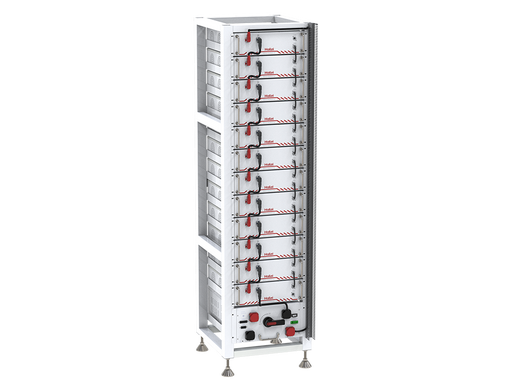
1. Flexible Adaptation to Scenario Requirements: Adjusting system capacity by adding or removing modules, for example, SOROTEC's SL-RH rack-mounted energy storage system supports 3 to 12 modules in series, with a capacity ranging from 15.36 kWh to 61.44 kWh, covering differentiated requirements for data centers and industrial applications.
2. Reducing Full Life Cycle Cost: Modular design extends the system's lifespan, allowing individual module failures to be replaced separately, avoiding overall scrapping. For example, the energy storage cells of BYD, with a capacity range of 800-1000 Ah, achieve optimal balance in thermal management and system compatibility, with BOM costs reduced by approximately 18% compared to cells above 1200 Ah, and maintenance efficiency increased by 30%.
3. Enhancing System Expandability: Standardized interfaces support seamless integration with photovoltaic inverters, UPS, etc. For instance, SOROTEC's SL-S-EU series high-voltage stacked energy storage batteries use plug-in connections, allowing expansion without complex wiring, with a protection level of IP65, suitable for indoor and outdoor environments.
II. Scenario-Based Selection: From Requirement Decomposition to Parameter Matching
Lithium battery selection requires a focus on scenario requirements, achieving precise matching through the "requirement decomposition - parameter calculation - category initial selection - compliance verification" four-step method.
1. Requirement Decomposition: Clarify priority of core indicators
Different scenarios prioritize different aspects of battery performance:
Home energy storage: Prioritize safety and cycle life, as lithium iron phosphate batteries have excellent thermal stability and a cycle life of over 6,000 times, becoming the mainstream choice;
Construction machinery: Require high-rate output (continuous discharge at 1C-2C, peak 3C-5C) and strong environmental adaptability (-20°C to 60°C), the lithium iron phosphate system combined with high-power BMS can meet instantaneous high-current working conditions;
Grid-level energy storage: Requires a balance between capacity and thermal management, 800-1200 Ah cells can achieve efficient heat dissipation through liquid cooling or immersion cooling, with a single container capacity reaching over 5 MWh.
2. Parameter Calculation: Lock in Key Indicator Ranges
Rated voltage: Needs to match the input voltage of the equipment, such as electric buses using a voltage above 600V, achieved through series and parallel connection of single cells;
Rated capacity and energy: Calculated based on power and working time, for example, a 100 kW equipment working for 3 hours requires approximately 350 kWh system (considering efficiency 0.85-0.9);
Discharge rate: High-power equipment requires 20C or higher discharge capacity, such as drone batteries need to support short-term high-power output;
Internal resistance and consistency: Low internal resistance (<3 mΩ) can reduce energy loss, the internal resistance difference of battery cells needs to be controlled within ±5%, avoiding the "sinker effect".
3. Category Selection: Based on Material Characteristics and Application Scenarios
Lithium-ion batteries: High energy density (200-300 Wh/kg), excellent low-temperature performance (-20°C environment with capacity retention rate > 80%), suitable for high-end electric vehicles and drones;
Lithium-iron phosphate batteries: Outstanding safety (passing UL9540A thermal runaway fire test), long cycle life, suitable for energy storage systems and electric buses;
Titanium oxide batteries: Ultra-long cycle life (> 20,000 times), suitable for extreme conditions (such as industrial monitoring, field equipment).
III. Practical Cases of Modular Solutions: Full-scenario Coverage from Home to Grid
1. Home Energy Storage: Flexible Expansion and Intelligent Management
The SOROTEC SL-S-EU series is launched for home users with eight capacity gradients ranging from 7.68 kWh to 25.64 kWh. The modules are connected by plug-in design and can be installed on the ground. The high-voltage control box can withstand a system voltage of 650V and has a continuous charging and discharging power of 25,600W. It is compatible with different brands of inverter communication protocols. Users can dynamically adjust the system scale according to electricity demand.
2. Industrial and Commercial Energy Storage: Balance of High Integration and Economic Efficiency
The SL-S-EC series high-voltage integrated system adopts a stacked design, with a single system rated capacity of 20.48 kWh. It supports CAN and RS485 dual communication protocols and can seamlessly connect with hybrid energy storage inverters. Its operating temperature range is -10°C to 50°C, providing a 5-year warranty, with a lifespan exceeding 10 years under one-hour charging and discharging conditions, significantly reducing the total life cycle cost.
3. Grid-level Energy Storage: Breakthroughs in Capacity and Thermal Management
Taking the EnerC series containerized energy storage system launched by CATL as an example, it adopts a modular design concept. Each box has a capacity of 3.44 MWh. Through liquid cooling thermal management technology, the temperature uniformity of the battery cells is controlled within ±2°C, effectively increasing the system cycle life to over 8,000 times. This system supports parallel expansion of multiple boxes, with a maximum capacity of 200 MWh per station, meeting large-scale energy storage requirements for grid peak shaving, frequency regulation, etc. Its modular architecture also has the "plug-and-play" feature. A single module failure can be replaced within 2 hours, with an operational efficiency 40% higher than traditional solutions. Additionally, the system's built-in intelligent BMS can monitor the state of battery cells in real time, combine with AI algorithms to predict remaining life, providing precise data support for grid dispatching. Through standardized interface design, the EnerC series can seamlessly collaborate with renewable energy generation equipment such as photovoltaic and wind power, forming an "source-grid-load-storage" integrated solution. This full-module design from battery cells to the system not only reduces the initial investment cost of grid-level energy storage projects but also adapts to the load characteristics of different regions through flexible expansion capabilities, providing a replicable technical path for the construction of new power systems.
How to Extend 18650 Cell Lifespan?
Sep. 22, 2026
What Are the Advantages of Lithium Marine Batteries?
Sep. 22, 2026